
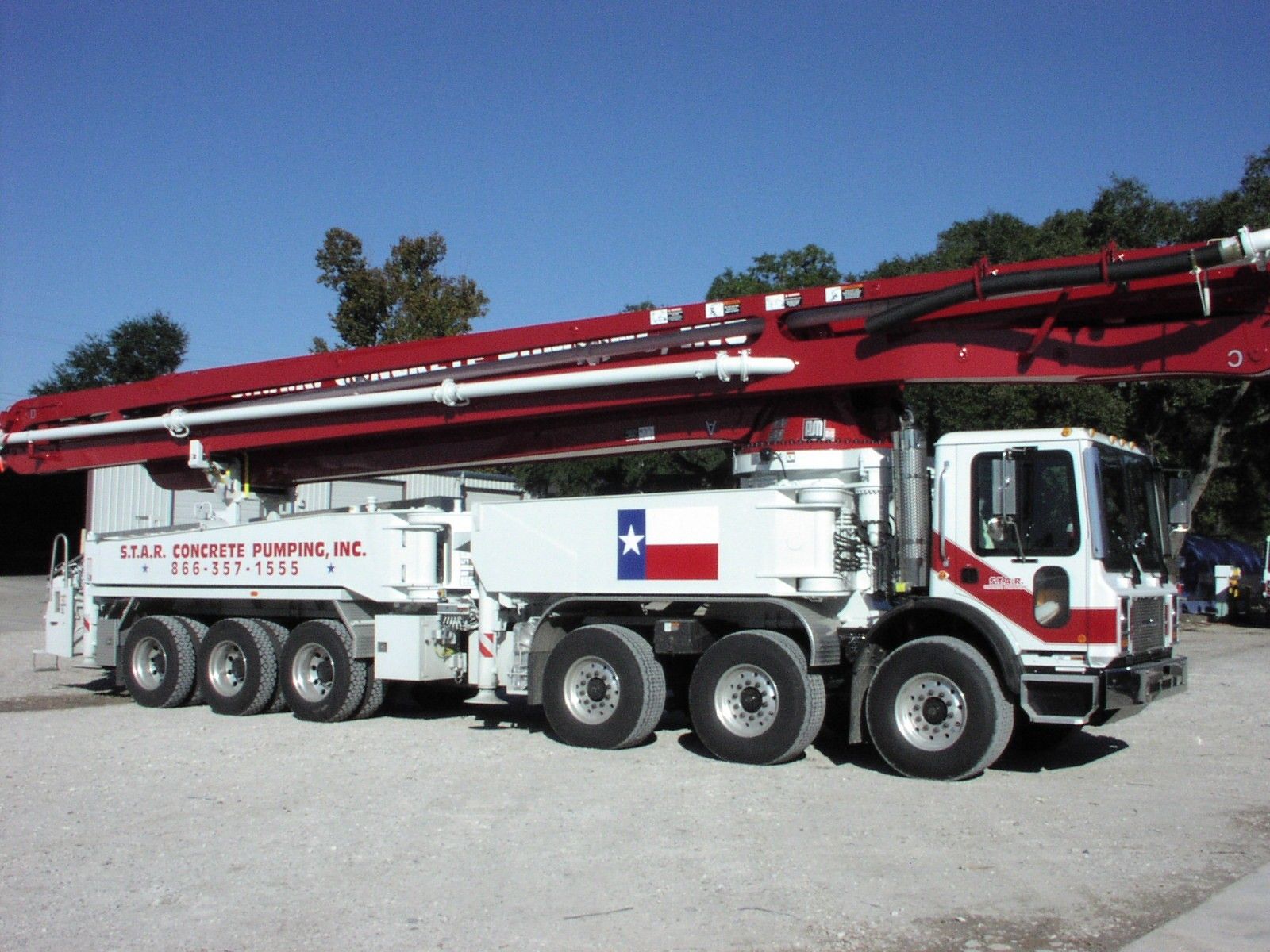
Boom pump fleet: 28 to 65 meters, Putzmeister and Schwing, serviced in Tomball.
Every boom class we run, with the manufacturer's published reach. Pick one below or let the reach finder pick it for you.
Which boom reaches your pour?
Type how high the top of your pour is and how far its far edge is from where the truck can park. The drawing shows the right boom reaching it, to scale from the manufacturer's spec sheet, and one sentence says which boom to order. Dispatch confirms the setup on the call.
Reach finder: how close can the boom pass to the edge of a hole? We use 2 ft. AnswerReach finder: a boom with little to spare. Name the next bigger boom, or say "call dispatch"? AnswerFrom the ground where the truck parks. Slab on the ground: 0. Basement or pit: type a minus, like -20.
Measure flat along the ground, from the closest spot the truck can stand to the farthest spot the concrete has to go.
Legs stay back from a hole at least as far as it is deep.
How will the truck park?
More about the site
Something in the way?
A wall, building or fence between the truck and the pour. The finder also checks that the boom can put concrete right behind it.
Wires, trees, roof or canopy over where the truck stands.
Numbers for the Putzmeister 38Z reference model, from its spec sheet. Vertical reach: ground to the boom tip. Out: boom straight out at pivot height. Reach depth: ground down to the end of the 10 ft hose. Clear air: what the boom needs over the truck to open. Leg spread: the wider of front and rear, fully out. Slope, soft ground, wires and where the truck can actually park change the real setup. That is what the dispatcher's questions are for.
What the numbers mean on a job
- Vertical reach is from the ground to the boom tip, with the boom straight up. It is the boom's length plus the pivot it rides on, 11 to 13 ft up on these trucks. A 38 meter: 108' 7" of boom on a 13' 2" pivot is 121' 9".
- Horizontal reach is from the center of the turret, with the boom straight out at pivot height. The turret sits 7 to 14 ft behind the front bumper on these models, and 10 to 21 ft in from the outside of the legs. The finder takes that off for you, so type the distance from where the truck can park.
- The edge is a circle, so reach out shrinks as you go up. The farthest the tip goes in any direction is the whole boom pointed that way. A 38 meter reaches 108' 7" out at pivot height, but only about 92 ft out to put concrete on a deck 60 ft up.
- The published numbers are to the tip. Concrete comes out of the 10 ft rubber end hose hanging below it. The finder checks that the hose can get to the top of your pour, not just the tip.
- Inside the edge, the boom folds up and over and comes down into the pour. At the edge it is straight with nothing left to give. The spec sheets mark the steep zone over the truck as no place to run the end hose.
- It reaches below grade. First section near level, the rest hanging down into a basement, pit or caisson. The published reach depth, 80' 1" on a 38 meter, is to the end of the hose. Type a minus height and how far the hole is from the truck to check one.
- It needs clear air to unfold, from 21' 4" on a 28 meter to 75' 6" on a 63 meter, over the truck before it can open. Look up at the setup spot, not just at the pour: roofs, trees, wires.
- Power lines: 20 ft from every part of the boom. Nothing within 20 ft of a line up to 350 kV, 50 ft above that. That is the ACPA rule, and OSHA's crane standard (1926.1408) uses the same 20 ft. If the boom could get closer, call the utility first and plan a dedicated spotter.
- Outriggers need room and ground. Fully spread they run 21' 8" side to side on a 38 meter and 42' 1" on a 63 meter, and one pad can carry tens of thousands of pounds. Firm ground, pads and cribbing under them, and stay back from an excavation at least as far as it is deep. The finder checks that rule for a hole.
- Why 10 percent to spare. The finder picks the smallest boom that reaches your pour using no more than 90 percent of its reach. Booms flex under a full line of concrete, the truck rarely parks exactly where planned, and a boom at full stretch is slow to place with. That margin is our rule of thumb, not a number from the spec sheets. Dispatch confirms the setup on the call.
Sources: the Putzmeister spec sheet for each reference model (reach, section lengths, reach depth, unfolding height, outrigger spread, truck length and height); ACPA, operation of placing booms when power lines are present; OSHA 29 CFR 1926.1408; DICA, the 1:1 rule for safe setup.
The numbers, by class.
One reference model per class. Our unit list with counts per base follows once it arrives from the sales team. Are the brands right, and who can send the fleet list by size? Answer
Tight sites, foundations, slabs with close access, residential scale industrial work.
A 28 meter boom pump (Putzmeister 28Z reference model) reaches 89' 7" up and 78' 1" out from the center of the turret, and 54' 6" below grade to the end of the hose, with 4 boom sections and a 5 in delivery line. It needs 21' 4" of clear air to unfold; the outriggers spread 20' 5" front and 8' 7" rear.
The everyday commercial boom: tilt wall, decks, warehouse slabs.
A 36 meter boom pump (Putzmeister 36Z reference model) reaches 116' 10" up and 103' 0" out from the center of the turret, and 78' 5" below grade to the end of the hose, with 4 boom sections and a 5 in delivery line. It needs 27' 11" of clear air to unfold; the outriggers spread 18' 1" front and 23' 0" rear.
Mid rise decks, large slabs, water treatment structures.
A 38 meter boom pump (Putzmeister 38Z reference model) reaches 121' 9" up and 108' 7" out from the center of the turret, and 80' 1" below grade to the end of the hose, with 4 boom sections and a 5 in delivery line. It needs 28' 7" of clear air to unfold; the outriggers spread 20' 7" front and 21' 8" rear.
Data center mats, plant foundations, long reach over obstructions.
A 47 meter boom pump (Putzmeister 47Z reference model) reaches 151' 3" up and 138' 1" out from the center of the turret, and 105' 8" below grade to the end of the hose, with 5 boom sections and a 5 in delivery line. It needs 31' 2" of clear air to unfold; the outriggers spread 26' 1" front and 29' 6" rear.
Big mat pours, LNG and petrochemical structures, reaching across a laydown yard.
A 56 meter boom pump (Putzmeister 56Z reference model) reaches 180' 9" up and 163' 9" out from the center of the turret, and 132' 3" below grade to the end of the hose, with 5 boom sections and a 5 in delivery line. It needs 40' 0" of clear air to unfold; the outriggers spread 30' 6" front and 39' 8" rear.
The longest reach on the job. Tank foundations, stacks, pours where the truck cannot get close.
A 63 to 65 meter boom pump (Putzmeister 63Z class reference model) reaches 203' 9" up and 190' 7" out from the center of the turret, and 151' 11" below grade to the end of the hose, with 5 boom sections and a 5 in delivery line. It needs 75' 6" of clear air to unfold; the outriggers spread 39' 8" front and 42' 1" rear.
Interiors, tight access, long runs where no boom can set up.
Figures: the Putzmeister spec sheet for each model named (28Z-Meter, CT 4650 US (2015); 36Z-Meter (2015); 38Z-Meter, CB 3689 US (2007); 47Z-Meter, CB 3692 US (2007); 56Z-Meter (2013); 63Z-Meter, CB 4388 US (2014)), read 10/4/2026. Real setups depend on outrigger room, ground and overhead obstructions.
What is behind the fleet.
More than 90 pumps: truck mounted booms from 28 to 65 meters, trailer and line pumps, a city pump, placing booms and specialty gear, from five Texas yards. More than 110 new boom pumps have been bought since August 2014 and the booms are replaced every four to five years, so the average boom is under four years old.
A boom pump that is down on a job is a missed pour, so the shop matters as much as the iron. Our own mechanics in Tomball handle diesel, hydraulics, boom and pipeline, with field calls when a unit is down on site. How many mechanics in the Tomball shop, and what are the shop hours? Answer
Beyond the booms.
- Putzmeister RS 850 self jacking placing boom towers for high rise cores and elevated decks.
- BSA 2110 HP-D line pumps, a 13 HPD truck mounted pump and a truck mounted city pump with a 2110 pump kit for long line and tight access work.
- Hydraulic mini placer spiders and line dragons, so nobody is dragging hose by hand on the deck.
Delivery line wall thickness and boom inspections run on a schedule. A blown pipe is the accident every operator has heard about. How should we describe how Star inspects booms and pipe? Answer
Big pours start before daylight. The boom, the line and the operator are on site before the first truck, not after.
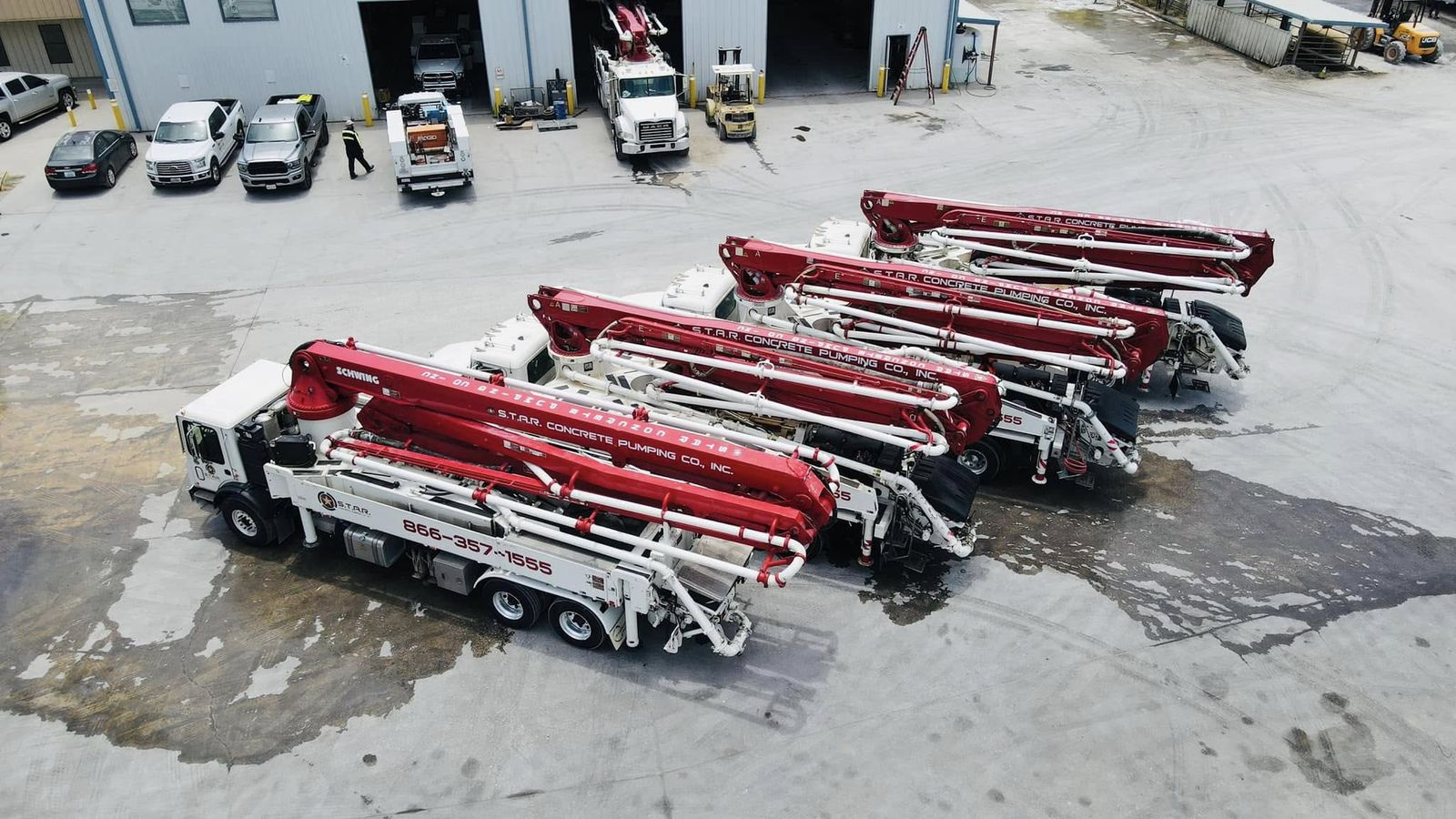
Questions about reach and setup
Horizontal reach or vertical reach: which number matters?
How much room does the truck need?
Where is boom reach measured from?
Can you pump farther than the boom with line?
What do you run?
Not sure which boom?
Give dispatch the pour, the yards and where the truck can park. That is the whole conversation.
Or call dispatch, (281) 357-1555.